1
Brand names, in three languages
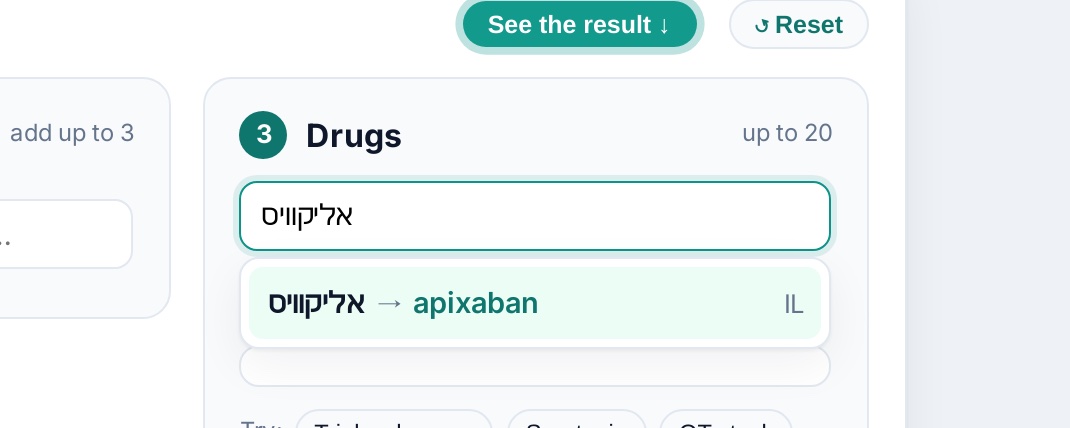
Eliquis, its Hebrew name אליקוויס, or Depalept: clinicians type what is on the box. PolyScope finds the active substance — apixaban, valproic acid — and works on that.
 PolyScope
Research demonstrator · synthetic data · not for clinical use
Major alerts stay interruptive. Every decision is explained, traced and can be replayed.
PolyScope is an explained polypharmacy review. It shows how risk converges as drugs stack up, in the context of the patient's kidney and liver function, lab results and conditions — and it says clearly what it could not assess.
No price, no advertising, no commercial purpose — for clinicians, pharmacists, researchers and healthcare institutions alike.
Several drugs that each add a little bleeding risk, kidney strain or QT prolongation can look acceptable pair by pair. Together, in an older patient with reduced kidney function, they may not be. And when every pair is flagged, the alert that matters is easy to miss.
Three separate alerts, no patient context.
Synthetic patients. Each picture is the real screen of the demonstrator.
Eliquis, its Hebrew name אליקוויס, or Depalept: clinicians type what is on the box. PolyScope finds the active substance — apixaban, valproic acid — and works on that.
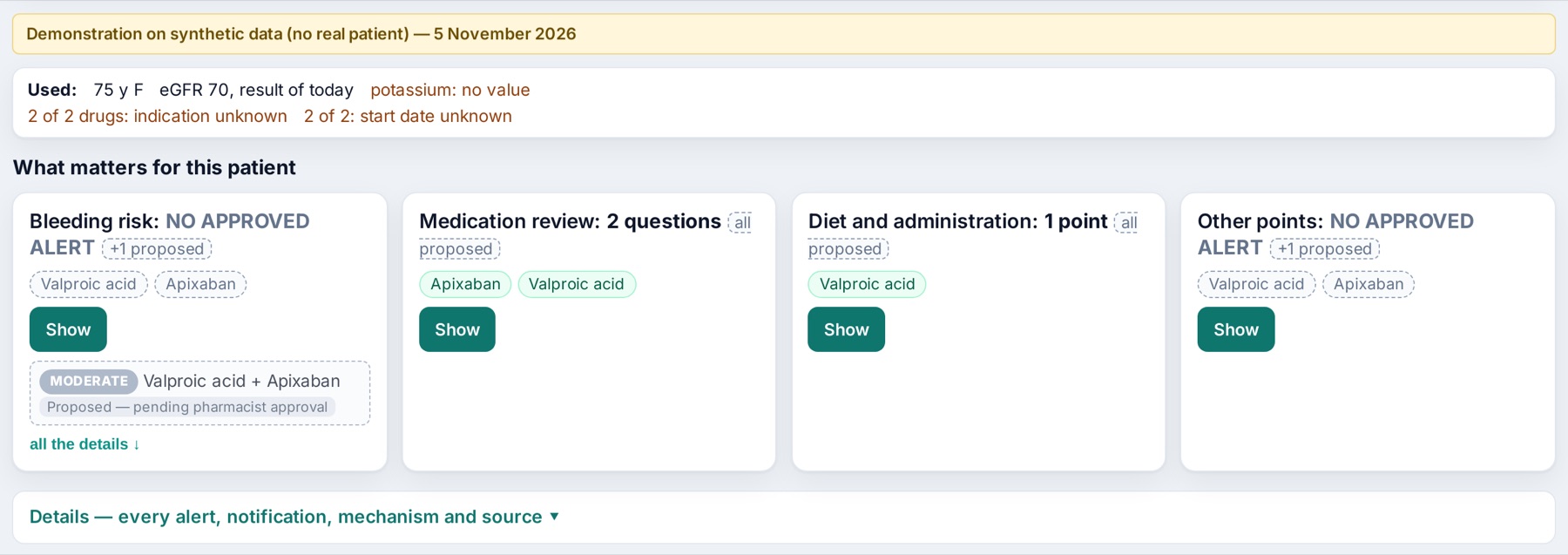
75 years old, atrial fibrillation and chronic kidney disease, on apixaban and valproic acid. PolyScope points to an added bleeding risk, clearly marked as proposed, with its source one tap away.
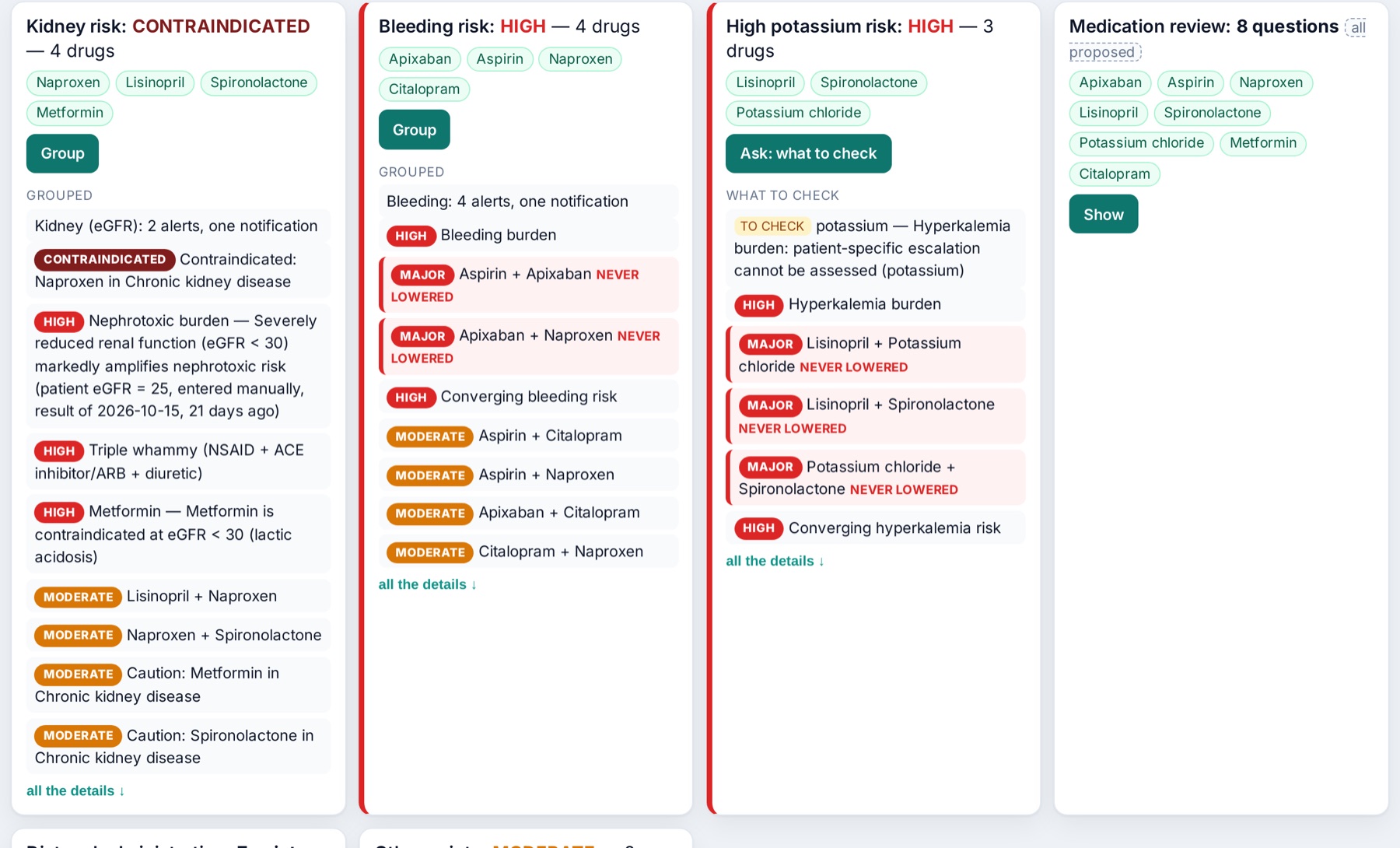
84 years old, kidney function at 25, eight drugs. Instead of one alert per pair: the kidney, bleeding across four drugs, potassium across three, and the rest. Major alerts are always shown. The missing potassium value is named.
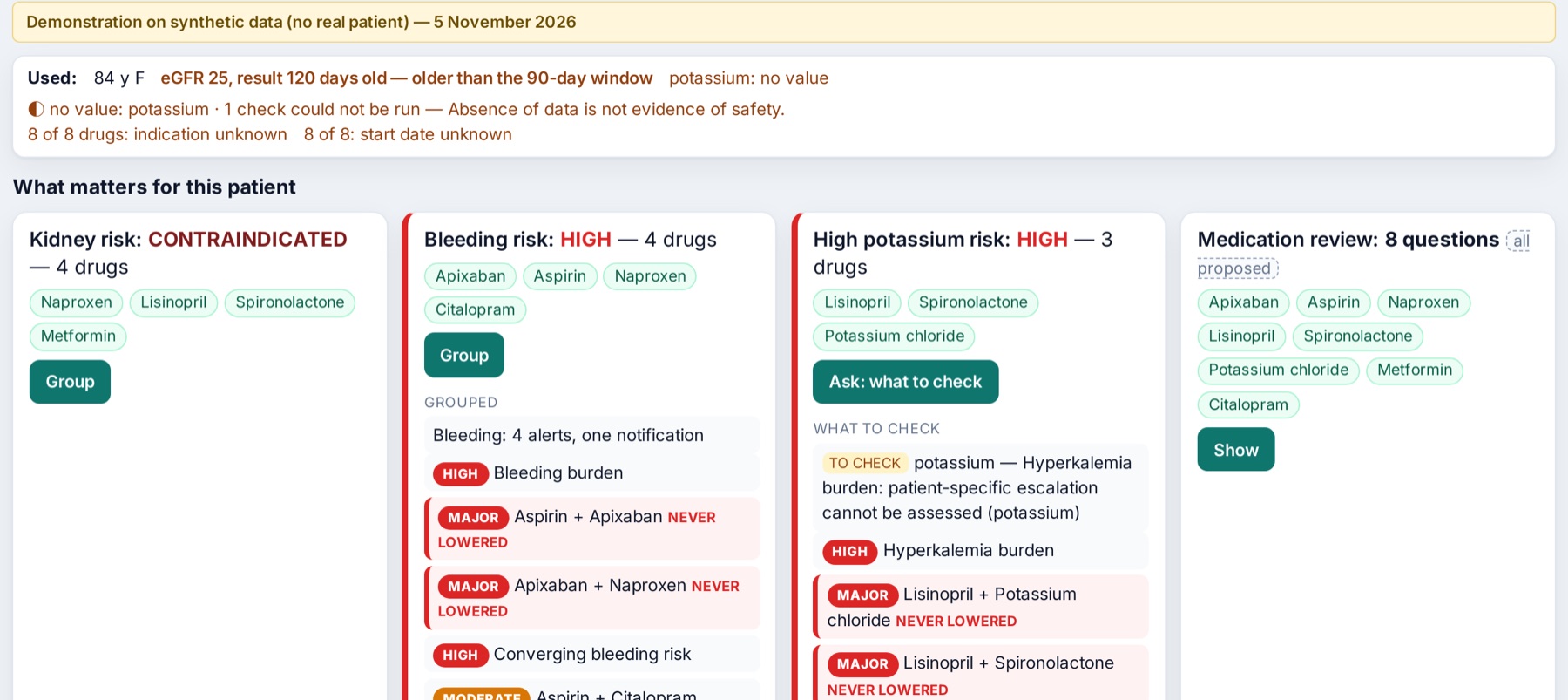
The same patient, but the kidney result is four months old. PolyScope says so, and asks for a new value instead of deciding on old data. Doubt never makes an alert disappear.
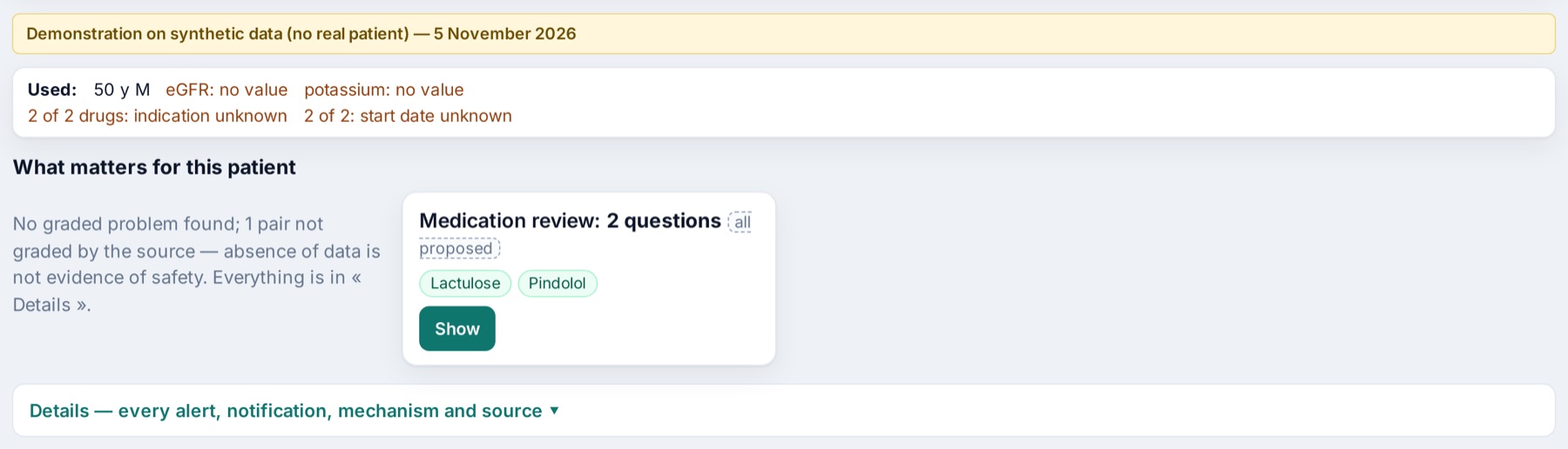
Lactulose and pindolol. No problem found, and PolyScope says exactly that — including the one pair its source has not graded. Missing data is never presented as safety.
For each medicine: why it was started, when, and when it should be looked at again. PolyScope asks the questions a review needs — no recorded reason, a review date passed, a usual treatment length exceeded, a drug that may be treating the side effect of another. These questions are proposals, not yet activated.
Grapefruit, alcohol, salt substitutes, dairy and calcium, when to take each medicine and which ones to take hours apart — taken from each drug's own label. It asks about the diet when it matters for this patient. This advice is a proposal, shown on the screen only — never in the report for the patient.
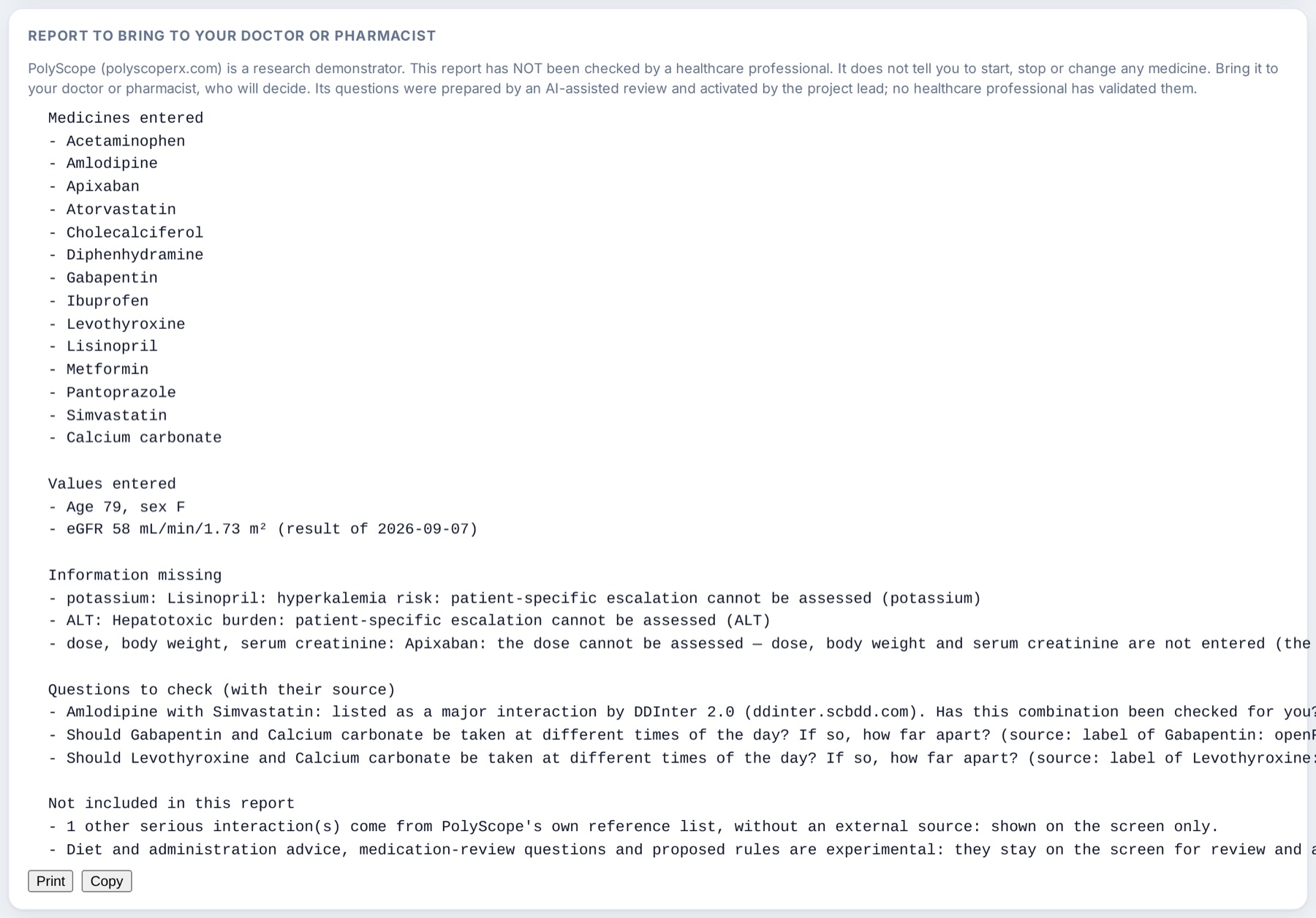
The medicines entered, the information still missing and questions with their sources — ready to print or copy, to bring to the doctor or pharmacist. It contains no diet or treatment advice.
Adds up each drug's contribution to the same risk — bleeding, kidney, QT, sedation, anticholinergic load, serotonin, potassium — across the whole prescription.
Takes the patient's conditions and dated lab results into account, and flags values too old to rely on.
Which drugs contribute, through which mechanism, on which sources — and what to check next.
When information is missing, PolyScope says so instead of staying silent.
Type the name on the box — in English, Hebrew or French. The active substance is found for you.
Why each drug was started, when to look at it again, and the questions a review should ask.
Food, drink and supplement advice from each drug's label, and which medicines to take apart.
A version runs entirely inside a hospital's own network, with no internet connection.
A synthetic patient from a cohort of 2,000 — or your own fictitious patient: age, sex, a few lab values.
Up to twenty drugs and twenty additional conditions, typed by brand or generic name.
Explained alerts, shown side by side with what a pairwise checker would report.
Medication review at admission and discharge, in internal medicine and geriatrics.
Structured medication reviews: reasons for each drug, review dates, diet advice.
Fewer interruptions for clinicians, with every alert still there.
A patient-aware layer on top of the interaction alerts you already provide. Let's talk.
Hospital pharmacists and physicians, for medication review at admission and discharge — especially in internal medicine and geriatrics, where clinical pharmacist time is scarce. We are looking for a hospital partner for a first pilot.
Yes. PolyScope is free, without advertising and for no commercial purpose — for individuals and for healthcare institutions. Some of its data come from sources licensed for non-commercial use only.
No. The demonstrator runs only on synthetic patients. Never enter real patient information.
No. It is a research demonstrator, before any regulatory step. It must not be used for clinical decisions.
Public sources, named on every alert: DDInter 2.0, openFDA drug labels, SIDER 4.1, TWOSIDES and the FDA's tables of drug metabolism. Licences and attributions are in the terms of access.
English, Hebrew (right to left) and French, for the screens and for brand names. The consultation report is in English for now.
Yes. A version runs entirely inside a hospital's network, with no internet connection and no data leaving it.
Request access with your name, organisation and profession. Each request is read by a person; you then receive your sign-in. Access is personal.
Please do, at fred@polyscoperx.com. Comments from pharmacists and prescribers are what makes it better.
The demonstrator is open to healthcare professionals, researchers and partners. Send a request: your account is activated once it has been reviewed.